Friday, 20 October 2017

Mushroom omelette with spinach and pomegranate

Ingredients:

2 eggs beaten
1/4 onion, sliced
4 white button mushrooms or 2 large brown mushrooms, sliced
salt, pepper
1 handful spinach
1/4 cup pomegranate

Method:

Put 1 Tbsp coconut or olive oil into a pan.  Add onion and fry till fragrant, add mushrooms.  Once mushrooms start to wilt, add in beaten eggs to cover the vegetables.  Allow mixture to firm in the pan on low heat.  Flip it over to cook the other side for another 2 minutes.

Take omelette out and serve on a wide flat plate.  Put spinach and pomegranate.  Serve.

Wednesday, 18 October 2017

Inflammation: Problems with anti-inflammatory drugs and what you can do naturally

Inflammation is a biological response in our body to injury, infection or irritation to remove damaged cells and tissues and initiate repair.  It is likened to the lighting of a spark to attract attention of the immune system to hasten the healing process.  The hallmarks of inflammation include redness, pain, swelling and heat. More severe inflammation can lead to loss of function. Some or all the hallmarks may be present. Acute inflammation is necessary to move white blood cells to the area of need to carry out biochemical events to help the tissues heal. 


Long term inflammation that is not resolved will result in chronic inflammation.  That is when the spark that was intended to help the tissue heal or remove the irritation now turns into a forest fire.  When chronic inflammation happens, the conventional medical treatment is to use anti-inflammatories, which is commonly in the form of non-steroidal anti-inflammatory drugs.  These drugs can have many undesirable side effects, for example the increase in cardiac risk from the use of diclofenac sold under tradename like Voltaren. In 2004, the FDA in the US pulled a drug made by Merck, used for arthritis, Vioxx, off the market because of the increase in incidence of stroke and heart attack from its use. 

Think about this:  if pain and inflammation is a signal from your body to tell you that you are out of balance, why do you shut off that signal?  If your car dashboard has a red light, wouldn’t you want to know what has triggered the red light to happen?  You won’t use a hammer and smash the red light or use a plaster to cover over the red light, so that you don’t see it.  Why do we do that to our bodies?

We need to deal with the underlying cause of inflammation.  Identifying whether the source inflammation is from the diet, lifestyle, mental states e.g. stress, insomnia or depression; lack of nutrition, excessive exercise or increased exposure to toxins is important to treat the cause rather than just the symptoms.  It is important to maintain good quality of life whilst you correct the underlying physiology and using natural anti-inflammatories in therapeutic doses like turmeric, fish oil, astaxanthin and mineral combinations can help to manage the cause of inflammation without undesirable side effects.

One man’s meat is another man’s poison.  Addressing your individuality and which food works for you and which ones do not can reduce a large inflammatory burden on your body.  A review of your toxin exposure, exercise and lifestyle can also reveal where other triggers for inflammation are for you.  Your naturopathic or functional medicine doctor will be able help you do that.  Most of your diet should be made up of good, wholesome, clean food, not necessarily raw, but lightly cooked to assist digestion and uptake of nutrients.  You do not need to be vegan to reduce inflammation, as long as food is nutritious and wholesome, you will benefit.  As to which food items are setting off your inflammation, this needs a personalised approach and it is advisable for you to seek professional help.


So when the dash board light comes on, be curious!  Find out what is driving that problem, do not put out the light by just shutting it down.  The engine could be struggling hard and is a ticking time bomb waiting to burn out or break down.

Tuesday, 1 August 2017

Does coconut oil or saturated fat cause heart disease?

Many people are very confused.  One moment you hear that coconut oil is good for you, then the media will refute that to say that coconut oil is bad for you, because can cause heart disease.  Whom should you believe?  Nutrition has become a bit of a religion.


There is no evidence to show that low fat and low cholesterol diets will prevent heart disease.  NO evidence.  75% of the cholesterol that we have is produced by our liver, it’s not even from the diet!  The whole low fat diet for heart disease was flawed.  This led to a 2015 revision by the USDA on dietary fats and cholesterol.  New Zealand has also revised its food pyramid.  It is widely recognised that the recommendation of eating 6-11 servings of bread, pasta, rice and grain products daily (the broadest base of the food pyramid) and focusing on a low fat diet has not seen a decrease in cardiovascular diseases in the last 30 years.  In fact to the contrary!  The revised base of the food pyramid is now lots of vegetables and water.

So, what’s the story with coconut oil if it cannot be related to heart disease?  The statin and pharmaceutical industry has educated us that high LDL cholesterol cause heart disease. This is wrong! We should be focused on the protective cholesterol that will prevent us from getting heart disease and that’s HDL cholesterol (the good cholesterol).  And the fact is that coconut oil raises HDL!  We need good saturated fat like what we get from coconut oil to make good cell membranes, cholesterol, sex hormones and brain cells. However, combining saturated fats, including that from coconut oil with a high sugar, high starch and low fibre diet will cause inflammation and heart disease.

So is coconut oil good?  Coconut oil increases HDL, which decreases the Total Cholesterol to HDL ratio, which is a good predictor of heart disease.  Coconut oil improves the quality, size and type of cholesterol.  Cholesterol is dangerous if it is small and dense, but is fine if it is large and fluffy.

The medium chain triglycerides in coconut oil (MCT) boosts metabolism and improves cognitive function.  Lauric acid in coconut oil is antimicrobial and antifungal.  Another good source of lauric acid is breast milk – which is 24% saturated fats! 

I would recommend using a combination of coconut oil and olive oil in your daily intake.  Coconut oil is great for anything that needs to be heated up and olive oil in your salad dressings and low heat cooking or cold food.  Olive oil has been used widely in the Mediteranean and this region is known for its heart healthy food intake.  And do not take coconut oil with high sugar and high starch.


Friday, 21 July 2017

Organic Foods and Gluten Free Foods are not necessarily healthy

There is an increasing awareness on the accumulation of pesticides and chemicals in our food chain.  Organic food purchase is on the rise.  Studies have always wanted to defy the nutritional contents of organic food, i.e. the vitamins and minerals in the organic food that it is no better than conventionally grown food.  However, these studies have not considered how much resilience a plant without pesticides needs to have in order to survive, and when we consume organic foods, we are consuming this resilience and ability to thrive.  These are minute phytochemicals produced innately by the plant that is beneficial for us.

Gluten Free is a term used to define grains that do not contain gluten, namely rice, buckwheat, quinoa, millet and amaranth.  Root vegetables, vegetables, fruits, seeds and nuts do not contain gluten either.  When foods are sold as fresh produce, the contents is 100% of the produce itself, e.g. an avocado is 100% avocado, a capsicum is 100% capsicum.  There is no question of gluten, hence no need for the label gluten free, unless it is whole wheat, barley, rye, oat or spelt.  The problem arises when foods are processed, e.g. the making of gluten free biscuits, the contents may be made of sugar, butter, rice flour and potato flour.  A gluten free biscuit made out of sugar, butter, rice flour and potato flour is gluten free but high in sugar.  Everyone of the content in that biscuit other than butter is or will convert to sugar, making that biscuit a sugar load!


There are many parties that have jumped onto the organic and gluten free band wagon, including gluten free cereals, gluten free sausages, gluten free cakes and biscuits, and the prices can be many times that of their conventional counterparts.  Gluten has been shown to be a problem for many people even if they are not coeliacs.  You can only be celiac if you have the gene transcription for it.  However, you can still have non-celiac gluten sensitivity, which creates many problems, digestive or otherwise.  The solution is not to get out there and buy gluten free substitutes but to go back to the drawing board and consume organic, whole foods that are rich in nutrients and low in processing.

Wednesday, 17 May 2017

7 foods to avoid if you have GERD/ heartburn


Whether you have a sour taste regurgitating at the back of your throat, or a burning sensation in your digestive tract, coughing and choking in the middle of the night or have griping chest pains that is not a heart attack, you have heartburn or reflux. 

Lifestyle and diet changes can help heartburn.  The 7 top foods that I have observed, when removed help reduce incidence of heartburn:
  1. Coffee – the acidity and caffeine exacerbates acid reflux
  2. Chocolate – have been found to be a common culprit in heartburn
  3. Tomatoes – especially acidic tomatoes, non-acidic tomatoes are usually fine.
  4. Alcohol – some people use alcohol to help relax and fall asleep but it is precisely the acid reflux that wake them back up! 
  5. Spices – cayenne, garlic and onions
  6. Gluten – it is hard to digest, especially if there are gastrointestinal problems, and starts to ferment in the stomach, creating pressure to bring up acid
  7. Flour products – processed foods made out of flour can be a problem with acid reflux – breads (even gluten free ones), pancakes, etc.  Eat whole foods, rather than processed foods made out of flours, worse if it is white!
And don’t eat close bed time.  Sit upright and chew you food, 20 chews per mouthful. Your stomach does not have teeth, you need to make it easy to breakdown.

Super Seed Crackers


¼ cup chia seeds
1 cup hot water
½ cup pumpkin seeds
½ cup sesame seeds
¼ cup linseeds/ flaxseeds
½ tsp salt (or less)
Flaky Salt to sprinkle

Preheat oven to 160C fanbake and line 2 oven trays with baking paper

Mix chia seeds with hot water stirring well with spoon in a medium bowl and allow to stand while the chia seeds absorb the liquid (about 10 minutes).  Stir in all remaining ingredients except salt to sprinkle.  Divide between the prepared trays and press out to roughly flatten with spoon.  Place a second sheet of baking paper over the top of each and roll out as thinly as possible with rolling pin (around 3mm thick).  Remove the top sheet of paper and sprinkle the cracker mix with flaky salt.


Bake for 30 minutes then remove trays from oven and flip the sheets of cracker mix and gently peel off the baking paper.  Return to oven and bake until they are crisp and firm and snap rather than fold when bent (a further 5-10 minutes).  Leave to cool and then break into crackers for a rustic look.  If you want them cut as neat crackers, bake for 20 minutes (rather than 30 minutes) before flipping, peel off baking paper and then cut into shapes.  Spread out on the trays and return to the oven to crisp (a further 15-20 minutes).  They will keep for weeks in an airtight container.

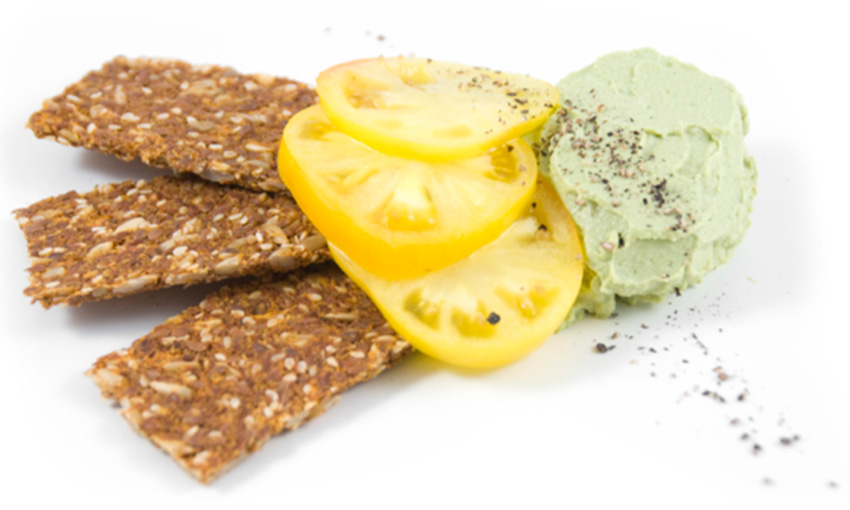
This recipe is with compliments from a client of mine, Felicia.  The crackers taste divine on their own or eaten with some guacamole, hummus or tomato and smoked salmon.

Monday, 3 April 2017

Feijoa Energy Balls

Feijoa Energy Balls
4 large feijoas, flesh removed
2 Tbsp almond butter or sunflower butter
2 Tbsp soaked chia seeds
1 Tbsp raw cacao nibs
5 dates soaked
desiccated coconut to roll

Put all ingredients in a blender and mix.  If it is too wet, add some protein powder to thicken.  Moisture can vary depending on size of feijoas and how juicy they are.

Roll into balls and roll onto desiccated coconut.  Chill for 1-2 hours.  Serve.